October 9, 2020
What is ‘IAP Merchandising?’

In my work with 35+ clients, ‘IAP Merchandising’ is a topic that I raise frequently, in service of improving IAP monetization.
But, I’ve found this term to be unfamiliar to many devs.
If that’s you, read on!
IAP Monetization Design
We’ll start with a more familiar concept: IAP Monetization Design.
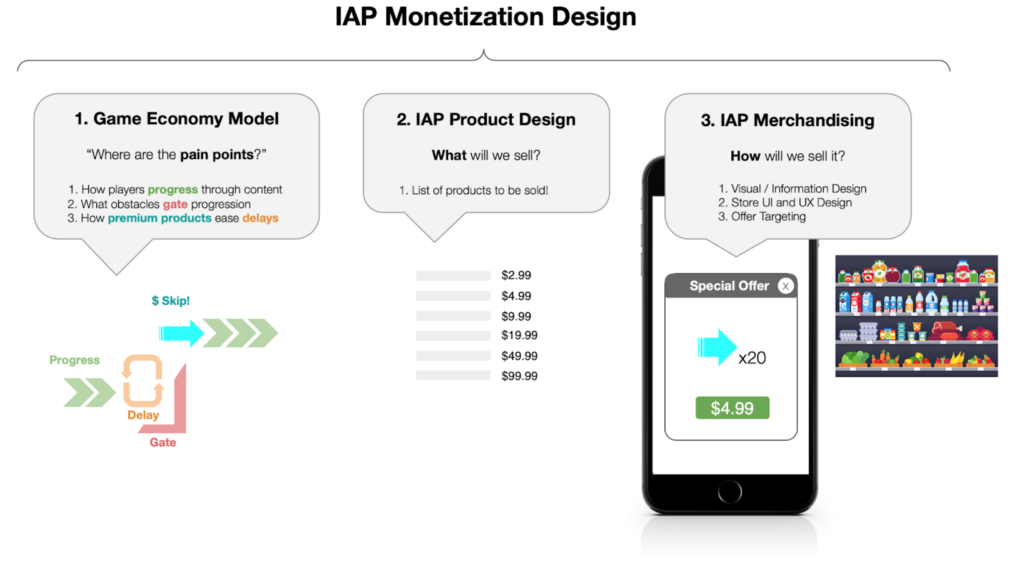
If we define IAP Monetization Design as encapsulating all considerations related to IAP monetization in a F2P game, then we can divide the discipline into three areas:
- The Game Economy Model
- IAP Product Design
- IAP Merchandising
1. The Game Economy Model
A Game Economy Model is the foundation of every successful game and answers three key questions: 1) how players progress through content, 2) what barriers gate or slow this progression, and 3) how spending real money helps players overcome those barriers more quickly.
The basic economy model can be expressed that simply: ‘gameplay progression works like X, is gated by Y, and players can overcome gates by purchasing premium products A, B or C.’
For example, in Candy Crush, the fundamental Saga Economy Model is:
Progression: Players progress by beating levels in a linear sequence.
Gates: Players lose lives on level failure. When empty, players must wait for lives to replenish. Pain is felt when progress is blocked by losses, and when players must wait for lives.
Premium Products:
- Boosters and Extra Moves help players beat difficult levels.
- Refill Lives or Infinite Lives allow players to bypass the wait.
2. IAP Product Design
The game economy model lays a mechanical foundation that allows for a set of premium ‘experience enhancers,’ like powerups, currencies and other items.
Combining these items and currencies in different amounts, and at various price points, results in a list of IAP products (bundles) to be sold in your game. Any discounted bundles (special offers) should also be in this list.
3. IAP merchandising
Given the list of IAP products and prices, IAP merchandising does the job of defining when, where, how, and to whom these products are actually sold.
Imagine that you have a stockroom full of toys to sell, but no store yet, and no labels, packages, price tags, artwork or sales copy. This is where IAP merchandising comes in.
IAP merchandising includes:
- Visual design
- Product appearance (art)
- Store appearance
- Value propositions, communicated via text and art
- User Experience design
- Segmentation: routing different offers to different player segments
- Appearance and ‘feel’ of premium currencies, consumables and collectables
- Store UX, layout, organizational structure
- Where, when and how products are shown outside the store
Key takeaway: Given a list of IAP products, IAP merchandising is the discipline that defines when, where, how (including appearance), and to whom these products are shown, both inside and outside the store.
To learn more about IAP Merchandising, check out The IAP Merchandising Playbook, Part I: Special Offers that Sizzle
——————————————————-
If you enjoyed this article, you might also like:
How to Fail in F2P Mobile Games, Part 1: Start without a Business Case
How to Fail in F2P Mobile Games, Part 2: Undisciplined Innovation
How to Fail in F2P Mobile Games, Part 3: Vague Product Goals
Need help with your game? Contact me!
Turbine helps mobile game & app publishers drive UA and product KPIs.
Book Intro Call