Field note · October 2, 2025
Do Supercell Games Succeed Because of — or In Spite of — Light-Touch Monetization?
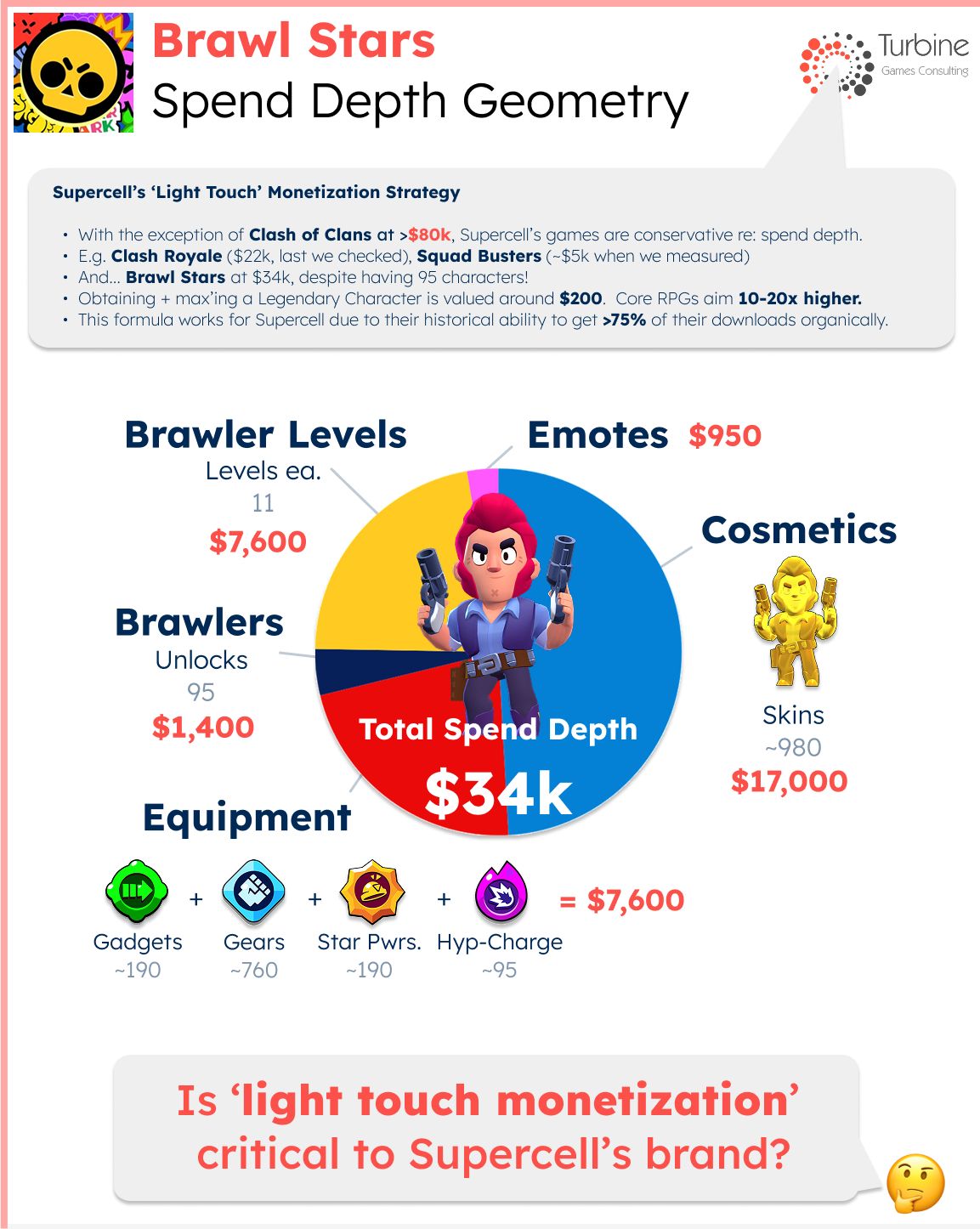
Do Supercell games succeed because of, or in spite of their 'light touch monetization' economies?
Clash of Clans ($80k) aside, Supercell is notably conservative re: spend depth.
Last time we checked,
- Clash Royale's economy had a total value of $22k.
- Squad Busters? $5k.
- Brawl stars? $34k.
Despite BS having 95 playable / upgradeable characters!
Now, $34k can sound egregious, until you consider Core games' (Team & Idle RPGs, 4X) $250k-$800k econs.
In these games (e.g. Rise of Kingdoms, AFK Arena, RAID) maxing a top-tier hero is valued at $2000-$4000.
In Brawl Stars, doing the same is only $200.
While not a Core RPG, IMO there's no mechanical reason why Brawl Stars couldn't 3x spend depth.
So, why don't they?
Is it because Supercell's brand (which yields 3-4 organics for every paid install) depends, in large part, on having 'lightly monetized' economies?
FWIW, 3:1 organic ratio is exceptional.
Rise of Kingdoms, AFK Arena, RAID are closer to 1:1 (Sensortower).
So if Supercell monetized more deeply/aggressively, would that put their organic UA machine at risk?
Is 'light touch monetization' critical to Supercell's brand?
Turbine helps mobile game & app publishers drive UA and product KPIs.
Book Intro Call View original on LinkedIn →